

Send Message
Privacy statement: Your privacy is very important to Us. Our company promises not to disclose your personal information to any external company with out your explicit permission.

Whether it's a home or a workplace, every space needs adequate lighting to provide utility. In order to achieve optimal lighting, several factors must be considered. These include brightness, color temperature, and the interior of the space. Apart from these, there is another important factor that you must consider. That is the beam angle, which is a measure of how light travels from the light source. This is one of the simplest metrics for optimizing the lighting of different spaces. However, it must be fully understood in order to make decisions accordingly.
What is beam angle?
Light consists of tiny particles called "photons" and when these photons are emitted, they have a certain trajectory. The angle formed by this trajectory is called the "beam angle". The mechanism for producing photons varies from one light source to another. As a result, the beam angle varies from light to light.
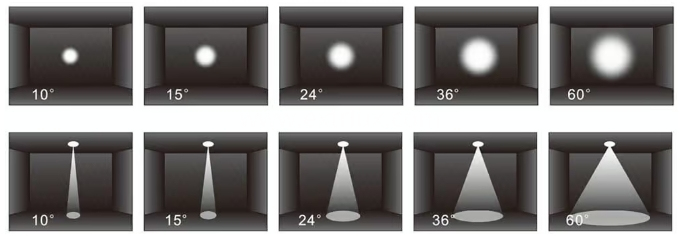
Beam angles are divided into several categories. They range from very narrow to very wide. Lights with wider beam angles are spread more widely. Conversely, narrower beams have a smaller spread. In addition, beam angle also affects light intensity because it depends on the overall spread. Light that spreads more will be less intense than light that spreads more narrowly.
The amount of light needed to illuminate a space depends on its area and the preferred light source. It is expressed in lumens and describes the intensity of light. The key is that larger sizes require more lumens than smaller sizes. Therefore, the light source should have a narrow beam angle to illuminate the entire space.
How does beam angle affect lighting conditions?
Beam angle affects the lighting conditions in a space by influencing the propagation of light. For example, two LEDs produce 600 lumens but have different beam spreads. A wider beam angle will illuminate more area than a narrower beam angle.
However, while a wider beam angle will provide more spread, the light will not be as intense. This is because the photons are spread over a larger area, dividing the intensity over a larger area. Conversely, a narrower beam angle will not produce as much diffusion, but it will be more intense. Again, a narrower beam will concentrate the photons in a more limited area.
Different spaces in homes and offices have different lighting requirements. For example, some areas need strong light for enhanced utility, while others need better spread. Therefore, you should choose a beam angle based on the utility and lighting requirements of a particular space.
The role of beam angle in different types of lighting
Each area has different lighting requirements that fall into three main categories. These include basic lighting, accent lighting and decorative lighting.
Basic Lighting
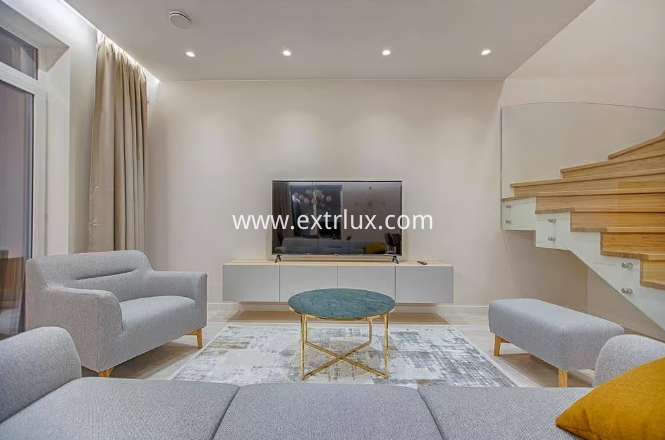
Basic lighting is the most common and widely used in all spaces. You often see this kind of lighting in living rooms, bedrooms, garages and bathrooms. It strikes a balance between intensity and spread. Typically, basic lighting covers the entire space with enough intensity to provide good utility. Beam angles for such lights range from 120 to 90 degrees, depending on the size of the area.
Accent Lighting
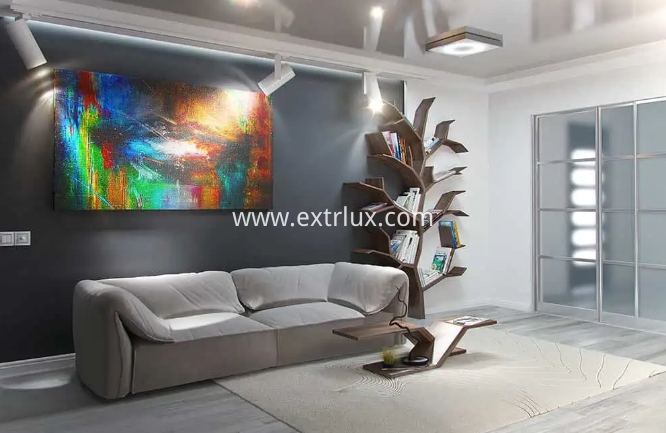
Accent lighting highlights specific areas of a space. For example, you can use it to illuminate a sitting area in a living room or to highlight the color of a wall. Because it doesn't require a wider spread, you can use light with a narrower beam angle. A light with this beam angle illuminates only selected areas and provides deep intensity. Typically, you use medium-narrow or narrow beam angles for accent lighting.
Decorative Light Fixtures
Decorative light fixtures, as the name suggests, are used for decoration. For example, you can use them to highlight decorative pieces or install different colored lights in certain parts of your house. Usually, narrow and very narrow beams of light are used for this purpose. These lights do not have to illuminate a large space, but rather a narrow area. Narrower angles provide just that, while providing more intensity.
How to choose the right beam angle?
Now that you know how beam angle affects lighting conditions, you must also know that there are several factors that determine the correct beam angle. You must consider the following factors to choose the right beam angle for a given space. Let's take a look at them:
Building type
The first thing you should consider is the type of building. You must know the size of the space, the height of the ceiling and the number of fixtures required. If a room has high ceilings and a small area, fewer fixtures will be needed. In addition, a narrower beam will work better for this type of space because not much spread is needed.
In contrast, a wider beam angle is better for larger buildings with lower ceilings. Choosing a narrow beam angle for this type of space produces less spread and is not enough to illuminate the entire area.
Most buildings have ceiling heights of approximately 7.9 to 8.9 feet. Lamps with a wider angle of 60 degrees are suitable for this type of structure. However, if the ceiling is higher than 8.9 feet, multiple lights will be needed. It helps if you choose a narrower beam angle to provide enough lumens.
Number of Lights
Different spaces vary in size and therefore the number of lights needed to illuminate it. This is an important factor to consider when choosing a beam angle. If the space requires two or more lights, the beam angle of each light must be estimated separately.
You must design a lighting plan and assign a portion of the area to each light source. The beam angle of that particular light source should cover the entire area and provide sufficient lumens.
Not all parts of a space need to have the same area. Therefore, the requirements for each section may vary. The key point is that you cannot select the optimal beam angle based on calculations for a single section.
Another key point is that all beams in a single space must overlap. Otherwise, there will be areas that do not receive light and will be darker.
Conclusion - Beam Angle
Beam angle describes the propagation of light, which is one of the most important factors to consider when lighting a space. Choosing the wrong beam angle can result in proper lighting that is too bright in some places and too dark in others. To find the right beam angle, several factors must be considered. The most important of these are the size of the ceiling, the height, and the purpose of the lighting. If you make your decision based on all of these factors, you will get the best lighting conditions possible.
LED Commercial Lightings, LED Ceiling Lights, LED Lamp Cups , LED Downlights, LED Panel Lights, LED Spot Lights, LED Downlight, LED Panel Light, LED Spot Light
Author:
Mr. Owen
Phone/WhatsApp:
June 16, 2025

March 19, 2025
August 07, 2024
No matter where you are, you ca n’t do without lamps. Different brands of lamps show different light source effects. Nowadays, led lamps are widely used. Want to know which brand of led lamp is good?...
There are many types of lamps on the market today, and different types of lamps have different decorative effects. Take the downlight. Downlight is an embedded-to-ceiling lamps, downlights concealed...
The living room generally needs bright lights, and the common living room lights include downlights, spotlights, crystal lamps, etc., and their styles are varied. Let's take a look at the living room...
LED test standard Semiconductor light-emitting diode (LED) is a new type of luminous body with high electro-optical efficiency, small size, long life, low voltage, energy saving and environmental...
Email to this supplier
Author:
Mr. Owen
Phone/WhatsApp:
June 16, 2025
March 19, 2025
August 07, 2024
CONTACT US


Privacy statement: Your privacy is very important to Us. Our company promises not to disclose your personal information to any external company with out your explicit permission.
Fill in more information so that we can get in touch with you faster
Privacy statement: Your privacy is very important to Us. Our company promises not to disclose your personal information to any external company with out your explicit permission.