Recently, the team of Prof. Liu Chuan and Associate Prof. Liu Baiquan from the School of Electronics and Information Engineering (School of Microelectronics) of Sun Yat-sen University (SYSU) has made important progress in the field of light-emitting diodes (LEDs). They accurately regulated exciton dynamics through the core/shell colloidal quantum well technology, which effectively reduced exciton composite defects, balanced charge injection, and suppressed the energy transfer between colloidal quantum wells. This innovative approach not only significantly improves the efficiency of LED devices, but also successfully integrates them with thin-film transistors and circuit boards to achieve active addressing, i.e., “pipeline” effect display.
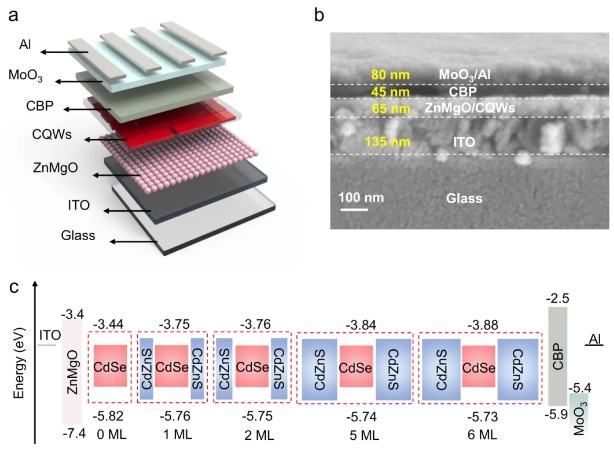
As a new type of nanocrystalline LEDs, colloidal quantum well LEDs have potential applications in the field of displays due to their high color purity, narrow half-height width electroluminescence performance, and solution processability. The team reveals the strong dependence between exciton generation and the thickness of the colloidal quantum well shell by deeply probing the effect of core/shell heterogeneous colloidal quantum wells with different shell thicknesses on exciton dynamics.
It is found that increasing the shell layer thickness within a certain thickness range can significantly increase the radiative compounding efficiency and reduce the Russo-cheese compounding, which substantially improves the overall performance of colloidal quantum well-LED devices. This in turn realizes high performance with high efficiency, high brightness and ultra-low efficiency roll-off. Its external quantum efficiency is as high as 13.43%, its current efficiency reaches 9.20 cd/A, and its power efficiency is 6.04 lm/W.
These metrics are the highest reported so far in the red light band (600-700 nm) of 2D nanocrystalline LEDs. In addition, the device shows only a slight decrease in external quantum efficiency from 13.15% to 12% during the brightness enhancement from 1000 cd/m2 to 10000 cd/m2, the best performance among the colloidal quantum well LEDs reported so far.

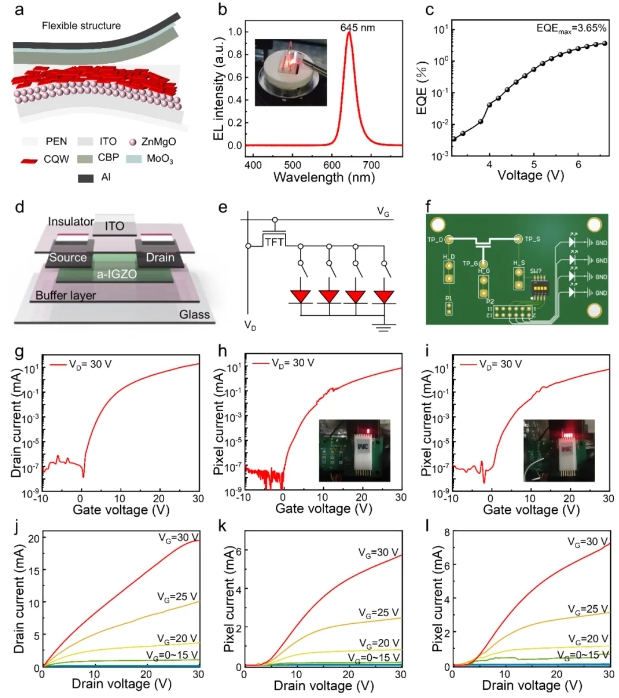
By combining with a PEN flexible substrate, a flexible colloidal quantum well LED is further realized with an outer quantum efficiency that is 40 times higher than the best previously reported flexible colloidal quantum well LED. The research team further utilized the high-current TFT driver circuit to successfully realize the selective pass control of single or multiple colloidal quantum well LEDs and realized the active addressing, i.e., the “pipelined” effect display. This achievement not only opens up a new way for further research and application of colloidal quantum well LEDs but also provides new ideas and strategies for the development of future display and lighting technologies.
The research results have been published in the internationally recognized academic journal Applied Physics Reviews, with the title of “Exciton control enables high-performance colloidal quantum well light-emitting diodes” and selected as a Featured Article. emitting diodes”, and was selected as a Featured Article.
The first unit of the paper is the School of Electronic and Information Engineering (School of Microelectronics) of Sun Yat-sen University (SYSU). Dr. Hu Sujuan, a doctoral student of SYSU, Mr. Xiang Wenbin, a doctoral student of Southeast University (SEU), and Associate Prof. Liu Baiquan of SYSU are the co-first authors of the paper, while Associate Prof. Liu Baiquan, Prof. Liu Chuan and others are the co-corresponding authors of the paper, Hong Kong University of Science and Technology. This work was supported by the National Natural Science Foundation of China (62104265) and the Science and Technology Program of Guangdong Province (2022A0505020022, 2021A0505110009).