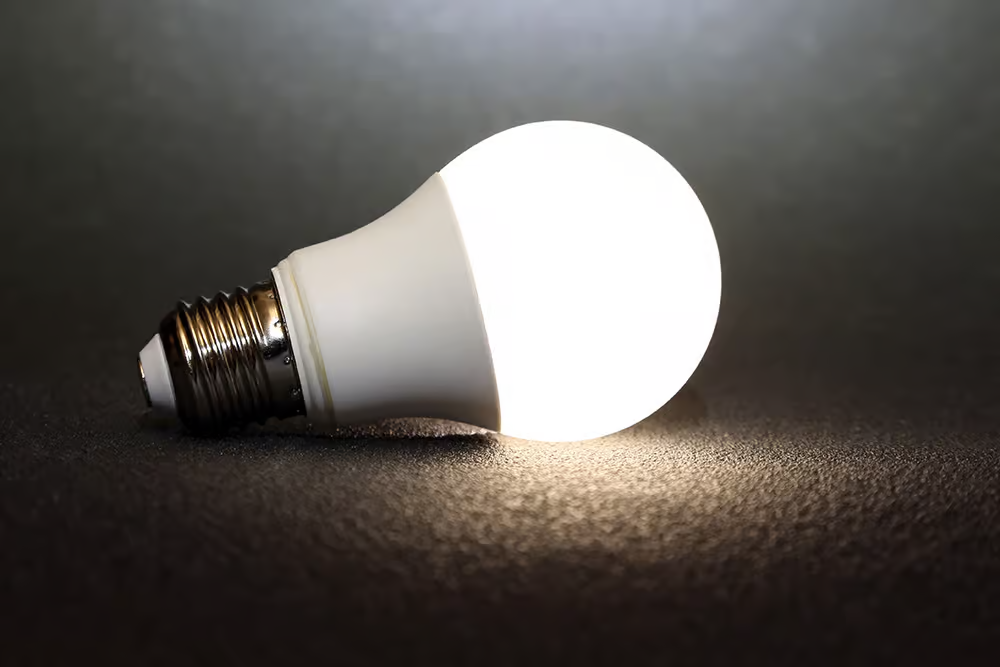
What are E26 and E27 bulbs?
E26 and E27 bulbs denote the size of the bulb base. Here, the term “E” stands for “Edison screw” and the numbers “26” and “27” define the diameter of the bulb base. The numbers “26” and “27” define the diameter of the bulb's base. The diameter of the base of an E26 bulb is 26 millimeters and the diameter of the base of an E27 bulb is 27 millimeters. While this 1 mm difference may seem negligible when physical properties are taken into account, when examined in depth, there are many differences in application.
1. Specifications and mechanical differences
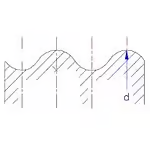
The International Electrotechnical Commission (IEC) has set specific standards for E26 and E27 bulbs. According to this standard, the minimum diameter of both E26 and E27 bulbs should be 26.05 m. However, the maximum diameter of E26 bulbs can be up to 26.41 mm, while the maximum diameter of E27 bulbs can be up to 26.45 mm. So you can see that the difference in diameter is negotiable. This means that mechanically you can interchange the two bulbs. You can easily install an E27 bulb into an E26 socket and it is very easy to do so. The main differences, however, are the length of the screws, the height of the insulating caps, and the width of the charged contact pads.
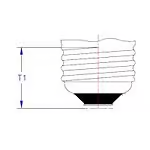
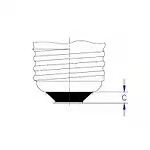
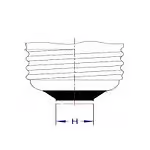
| Specifications | Screw Diameter at Thread Peak | Length of Screw (MIN) | Insulator Cap Height | Live Contact Pad Width |
| E26 Bulb | 26.05 – 26.41mm | 19.56mm | 3.25mm | 9.14 – 11.56mm |
| E27 Bulb | 26.05 – 26.45mm | 22.0mm | 5mm | 4.8 -11.5mm |
The most significant difference between E26 and E27 bulbs is the screw length. With screw length, it defines the distance from the head of the screw to the electrically charged contact point or the bottom of the bulb. The minimum screw length for E26 bulbs is 19.56 mm, while the minimum screw length for E27 bulbs is 22.0 mm. The reason for this huge difference is that they are rated for different voltages; I'll get to that in the next section.
Moving on to the height of the insulator cap, you'll notice a difference of 1.75 mm. The insulator cap in the E26 bulb is 3.25 mm, while the same cap in the E27 bulb is 5 mm high. Finally, the minimum width of the charged contact pad for the E26 bulb is 9.14 mm and extends up to a maximum of 11.56 mm, but in the E27 bulb, the minimum height of the contact pad can be 4.8 mm, with a maximum limit of 11.5 mm.
2. Voltage and Compatibility
The E26 bulb is designed to be rated at 120 V. Meanwhile, the E27 bulb is compatible with 240 V. Therefore, you can see that the E27 bulb operates at a lower voltage compared to the E26 bulb. While you can install an E26 bulb into an E27 socket, it is not safe. Replacing the bulb can lead to a fire and cause the bulb to be overpowered. This is why you should always use E26 bulbs in E26 sockets and E27 bulbs in E27 sockets.
| Type Of Bulb | Voltage Rating |
| E26 | 110V-120V |
| E27 | 220V-240V |
3. Electrical Safety
As you have learned from the previous section, the E27 operates at high voltage and the E26 at low voltage. Therefore, safety considerations are more important for E27 bulbs than for E26 bulbs.
If a bulb's screws are not aligned accurately, the distance between the fire and zero wire contacts is reduced. Ultimately, this can create a risk of arcing or short-circuiting. Therefore, to avoid this, E27 bulbs have a larger gap between the fire and zero contacts than E26 bulbs. As a result, E27 bulbs have a longer screw length, which ensures more accurate alignment of the screw in the socket.
Moisture and dirt buildup increases the risk of short circuits and electrical fires at higher voltage levels. This is why E27 uses a wider threaded slot diameter than E26 bulbs. This makes contact tighter and safer. As a result, the luminaire is further protected from moisture and debris entering the socket.
Therefore, from an electrical safety standpoint, E26 and E27 lamps may be interchangeable and mechanically similar. However, the potential for electrical fires and short circuits is higher when using E240 lamps in E27 sockets operating at 26 volts.
4. Regional compatibility
Due to the voltage differences between E26 and E27 bulbs, you will need to use the standard voltage for your country. For example, the United States uses 110-120V (60 Hz), while many other countries use 220-240V (50 Hz). This is why E26 bulbs are considered standard in countries such as the United States, Canada, Taiwan, and Japan. Similarly, European countries and Australia have a standard voltage rating of 240 V. Therefore, E27 bulbs are used as standard in these areas.
Is it safe to interchange E26 and E27 bulbs?
You can easily install E26 bulbs into E27 sockets. But does that mean they are interchangeable? The answer is no!
While E26 and E27 bulbs are mechanically interchangeable, they are not electrically safe. The difference between the heads of E26 and E27 bulbs is only 1 millimeter, so they are physically interchangeable. However, they have different operating voltages. An E26 bulb operates at 120 V, while an E27 bulb operates at 240 V. Therefore, installing an E27 bulb in an E26 socket is risky because it will crush the fixture. However, you can use an E26 bulb in an E27 socket, but it will not provide the expected performance.
Many suppliers and lamp manufacturers may claim that E26 and E27 bulbs are interchangeable. They will provide you with logic based on their physical compatibility. You can install an E26 bulb into an E27 socket and vice versa. However, based on their mechanical compatibility, it is incorrect to say that they are interchangeable!
The main reason E26 bulbs should not be interchanged with E27 bulbs is the difference in their voltage. The E26 bulb is designed to operate at 120V and the E27 bulb at 240V. If the E26 bulb is installed in an E27 socket, it will be overpowered. As a result, it is possible to damage the bulb and cause a fire. However, you can use E26 bulbs in E27 sockets. Although it does not provide enough voltage to the E27 bulb for optimal performance, it is electrically safe. However, it is best to connect the E26 bulb to the E26 socket and the E27 bulb to the E27 socket without interchanging them.